Best Software Company in India for Connected Business Systems & Product Scale
Digital Fabric Lab designs and develops custom software for businesses that need technology shaped around their operations, product goals and growth model. From SaaS platforms and ERP systems to CRM software, internal tools, workflow automation, business portals and AI-enabled applications, we turn business logic into software that teams can use, manage and expand.
Our approach connects product strategy, user experience, software architecture, development, integrations, data, quality assurance and launch planning in one delivery path. For public-facing products, we can also align the supporting website, landing pages, analytics and search architecture so the software enters the market with a stronger digital foundation.
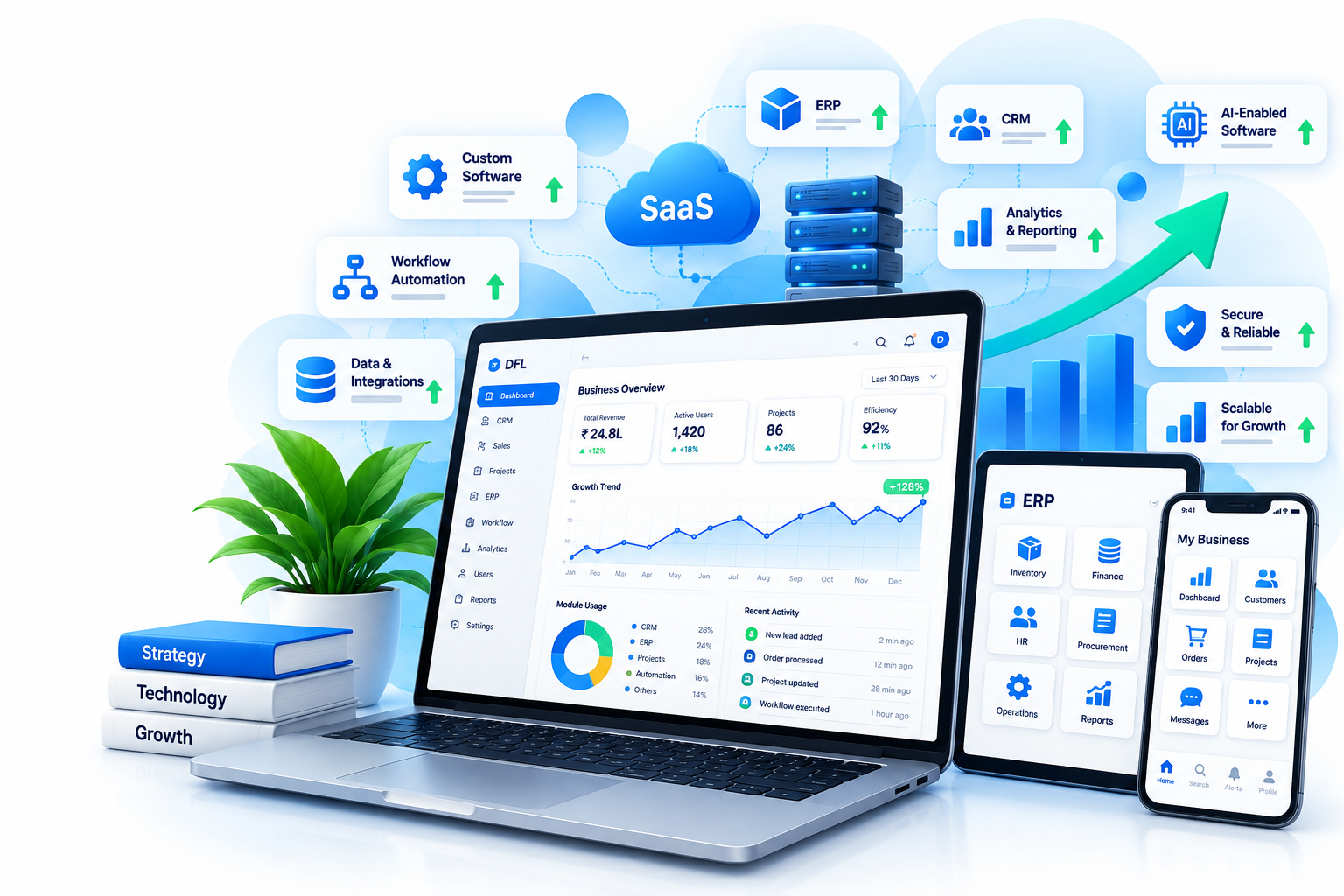
Engineer Software Around Your Workflow, Data & Growth Model
Custom software works best when the architecture reflects how the business creates value. We begin with users, workflows, permissions, data movement, integrations, reporting and future expansion, then translate those requirements into a practical system blueprint.
- Map the people, roles, approvals and actions the software needs to support.
- Define the data the business needs to capture, connect, calculate and report.
- Design modules around real operational journeys rather than isolated feature lists.
- Plan integrations with payments, communication tools, accounting systems, CRMs, marketplaces and third-party APIs.
- Create an architecture that can support new users, branches, modules, products and automation over time.
Custom Software Development Services for Operations, Products & Automation
SaaS Product Development
Multi-user and multi-tenant software products with authentication, subscriptions, permissions, dashboards, billing logic, analytics and product administration.
Custom ERP Development
Connected modules for operations, inventory, procurement, sales, finance, projects, HR, reporting and branch-level management.
Custom CRM Development
Lead, customer, pipeline, follow-up, communication, task, sales and reporting workflows designed around the business process.
Business Process Automation
Software workflows that route tasks, trigger actions, synchronize data, create alerts and reduce repetitive operational work.
Enterprise Software Development
Role-based business platforms, internal systems, operational dashboards and multi-department applications for complex workflows.
Customer & Partner Portals
Secure portals for customers, vendors, dealers, members, partners or employees with self-service workflows and controlled data access.
AI-Enabled Business Software
AI assistants, document intelligence, classification, recommendations, search, summarization and automation connected to business data and workflows.
API & System Integration
APIs, webhooks and integration layers that connect software with payment gateways, messaging, accounting, CRM, ERP, logistics and external platforms.
Turn Business Requirements Into a Connected Software Blueprint
A strong build starts before the first production feature is coded. Digital Fabric Lab structures requirements into modules, user roles, workflows, data relationships, integration points, dashboards, notifications and success metrics so product decisions remain connected to the business objective.
- User roles and permission matrix
- Module and feature ownership
- Core workflows and exception paths
- Data model and reporting requirements
- API and third-party integration map
- Dashboard and decision-support views
- Security, access and audit requirements
- Release priorities and product roadmap
Software Architecture Designed for Clarity, Reliability & Expansion
We select architecture and technologies around the product's users, data volume, integrations, release model and expected growth. The goal is a maintainable foundation that lets the software evolve without losing clarity as new modules and workflows are introduced.
Modular Application Architecture
Separate product capabilities into clear modules so teams can extend functionality with controlled dependencies.
API-First Connectivity
Use well-defined APIs and integration contracts to connect web, mobile, partner systems and external services.
Role-Based Access
Structure permissions around users, teams, locations, departments and operational responsibilities.
Data & Reporting Layer
Create reliable data structures for dashboards, filters, exports, operational reporting and management visibility.
Cloud & Deployment Planning
Align hosting, environments, storage, caching, monitoring and deployment workflows with the product's usage model.
Quality & Observability
Build testing, logging, error tracking and performance monitoring into the delivery workflow.
Technology Chosen Around the Product, Not Around a Template
Digital Fabric Lab uses modern web, backend, database, cloud and integration technologies based on the project requirements. The stack is selected for product fit, maintainability, team capability, performance and future development.
| Layer | Typical Technologies / Capabilities |
|---|---|
| Front End | React, Next.js, TypeScript, modern HTML/CSS and component-based interfaces |
| Back End | Node.js, PHP/Laravel, Python and API-driven application services |
| Data | PostgreSQL, MySQL, MongoDB, Redis and fit-for-purpose data models |
| Integrations | REST APIs, webhooks, payments, messaging, accounting, CRM/ERP and third-party services |
| Infrastructure | Cloud hosting, CDN, object storage, caching, CI/CD, containers and monitoring |
| Product Analytics | Event tracking, dashboards, operational metrics, conversion measurement and product usage signals |
The Digital Fabric Lab Custom Software Delivery Workflow
01. Business & Product Discovery
Understand goals, users, operations, data, dependencies and the commercial role of the software.
02. Requirements & System Mapping
Translate business logic into modules, workflows, roles, integrations and measurable product outcomes.
03. UX & Interaction Planning
Design user journeys, navigation, screen logic, dashboards and high-frequency actions.
04. Architecture & Data Design
Plan application structure, APIs, databases, permissions, integrations and deployment environments.
05. Iterative Development
Build product capabilities in controlled increments with regular review and functional validation.
06. Integration & Automation Layer
Connect payments, messaging, external platforms, internal systems and workflow triggers.
07. Quality Assurance & Launch Readiness
Validate functionality, access rules, responsive behavior, performance, data flows and production configuration.
08. Launch, Measurement & Product Evolution
Deploy the system, track usage and business signals, then prioritize the next product improvements.
Software Built for the Business Models That Need Connected Operations
SaaS & Technology
Subscription products, multi-tenant platforms, admin systems, usage workflows, customer portals and product analytics.
Education & Training
Student systems, learning operations, admissions workflows, dashboards, assessments, communication and administration.
Restaurants & Hospitality
Order workflows, menus, POS-connected operations, inventory, kitchen processes, CRM, payments and reporting.
Real Estate & Property
Lead management, inventory, broker/partner portals, listings, workflow tracking, documents and sales operations.
Healthcare & Professional Services
Appointments, service workflows, controlled access, customer communication, internal dashboards and operational reporting.
Retail, Distribution & Commerce
Inventory, orders, vendors, branches, fulfillment, CRM, dashboards and integration-led operations.
B2B & Field Operations
Lead-to-service workflows, approvals, task assignment, field tracking, reporting and customer/partner access.
Connect Software With the Systems Your Business Already Uses
Modern business software rarely works in isolation. We plan integration points as part of the system architecture so information can move between the custom platform and the tools used by customers, staff, partners and finance teams.
- Payment gateways and subscription billing
- WhatsApp, email, SMS and notification services
- Accounting and finance platforms
- CRM, ERP and marketing systems
- Maps, location and logistics services
- Identity, authentication and role management
- Marketplace and commerce platforms
- Analytics, reporting and data services
- Custom partner APIs and webhooks
AI Capabilities Added Where They Strengthen the Product Experience
AI can become part of the product architecture when it improves how users find information, process documents, make decisions, complete repetitive actions or interact with business data. We design AI features as connected product capabilities rather than isolated demos.
- Natural-language assistants connected to approved product data
- Document extraction, classification and summarization
- Search and knowledge retrieval across business information
- Recommendations and decision-support workflows
- Automated drafting, routing and task preparation
- Operational alerts and intelligent workflow triggers
Product UX That Helps Teams Learn, Act & Complete Work Faster
Custom software should make complex workflows easier to understand. We organize navigation, dashboards, forms, tables, filters, statuses, actions and notifications around the tasks users perform most often.
- Role-aware dashboards and navigation
- Clear task status and next-step visibility
- Fast forms and repeatable operational actions
- Responsive interfaces for desktop, tablet and mobile use
- Useful empty states, confirmations and system feedback
- Search, filters and reporting views aligned with real work
Public-Facing Software Can Launch With a Search-Ready Growth Foundation
Digital Fabric Lab is SEO-first at the company level, so when a software product also needs market discovery, we can coordinate the product with its public website, solution pages, documentation, analytics and conversion paths. This keeps the software engineering intent separate from SEO service delivery while giving the product a stronger launch ecosystem.
- Search-friendly marketing website architecture
- Product and solution landing-page ownership
- Analytics and conversion event planning
- Indexable documentation or knowledge content where relevant
- Technical SEO coordination for public web experiences
- Internal linking between product, use-case and supporting content
Why Digital Fabric Lab Brings Product Thinking, Engineering & Growth Together
Custom software decisions affect operations, customer experience, future releases and the cost of change. Our delivery model keeps business goals, UX, architecture, development, integrations, measurement and growth context connected from discovery through launch.
- Business logic translated into clear software modules
- Product decisions tied to user and operational outcomes
- Architecture planned with future modules and integrations in mind
- Web, software and SEO teams can coordinate when the product needs a market-facing growth layer
- Clear separation between custom software, web development and mobile app service intent
Service Intent Ownership & Internal Linking Architecture
| Page | Primary Intent Ownership |
|---|---|
| /custom-software-development/ | SaaS, ERP, CRM, workflow automation, enterprise/internal software, portals, APIs, business systems and AI-enabled software. |
| /web-development/ | Business websites, marketing websites, ecommerce sites, CMS builds, landing pages and website redesign. |
| /app-development/ | Android, iOS, Flutter, React Native, mobile MVPs and mobile-first application products. |
| /seo-services/ and SEO pages | Organic search strategy, technical SEO, content, local/ecommerce SEO, AEO, GEO and AI-search visibility. |
Recommended Internal Links
- /web-development/
- /app-development/
- /seo-services/
- /technical-seo/
- /cro-analytics/
- /case-studies/
Frequently Asked Questions
Create the Software Foundation for Smarter Operations & Product Growth
Whether you are planning a SaaS platform, ERP, CRM, workflow system, partner portal or a new business application, Digital Fabric Lab can help turn the requirement into a structured, connected software product designed for real users and long-term evolution.