Best SEO Company in India for Search Growth & AI Discoverability
Digital Fabric Lab helps businesses build a stronger search presence across Google organic results, Google Maps and AI-assisted discovery. Our SEO work connects technical performance, search intent, content depth, authority, entity clarity and conversion paths so visibility can support meaningful business growth.
We approach SEO as a connected growth system rather than a collection of isolated tasks. Every priority page is mapped to a purpose, every recommendation is tied to search demand, and every improvement is designed to make the website easier to crawl, understand, trust and act on.
Whether the goal is national lead generation, local visibility, ecommerce sales, B2B demand or stronger brand discovery in AI-led search experiences, the strategy is built around the searches that matter most to your business.
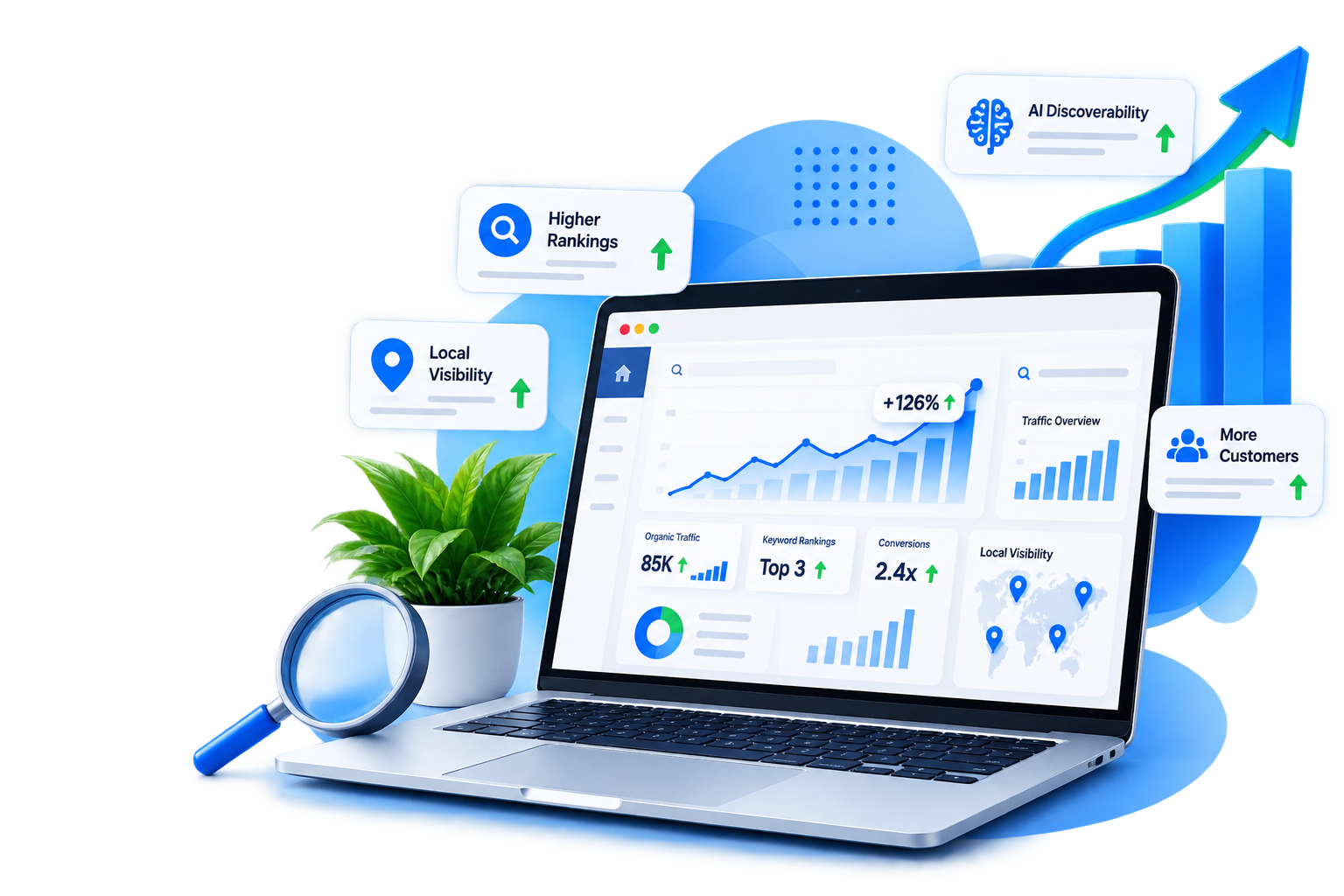
Turn Search Demand Into a Clear Growth Channel
The strongest SEO strategy starts by connecting market demand with the right pages. Digital Fabric Lab builds keyword-to-page ownership around discovery, comparison and action so users can move naturally from a search query to a relevant answer, service page, proof point and conversion path.
Capture high-intent commercial searches for services, products and solutions.
Expand topical coverage around the questions customers ask before they buy.
Strengthen local discovery for businesses serving cities, regions or multiple locations.
Create technically clean crawl and indexation paths for search engines.
Improve entity clarity and answer-ready content for AI-assisted discovery.
Connect organic traffic with calls, enquiries, demos, purchases and other business actions.
SEO Services in India Built as One Connected Search System
Our SEO services are structured as connected workstreams. The mix changes by business model, website condition, market competition and growth objective, while the core principle stays the same: every activity should strengthen discoverability, relevance, authority or conversion.
SEO Strategy & Search Opportunity Mapping
We map business goals to search demand, competitor coverage, page ownership and measurable opportunities. The result is a prioritized roadmap that shows where organic growth can come from and which pages should carry each intent.
Technical SEO
We work across crawlability, indexation, canonicalization, site architecture, Core Web Vitals, internal linking, structured data, JavaScript rendering, redirects, sitemaps and other technical signals that influence search access and page performance.
On-Page SEO
Titles, descriptions, headings, content structure, entities, topical relevance, media, internal anchors and conversion elements are aligned with the purpose of each page and the intent behind its target searches.
SEO Content & Topical Authority
Service pages, category pages, guides, comparison content, FAQs and supporting clusters are planned around useful topic coverage rather than keyword repetition. Content is designed to answer real search questions and reinforce subject authority.
Local SEO & Google Maps
For location-driven businesses, we connect location pages, Google Business Profile signals, local relevance, service-area content, reviews, citations and website architecture to improve discovery across local search journeys.
Ecommerce SEO
We optimize category architecture, product discovery, filters, faceted navigation, structured data, internal linking, content and technical foundations to capture transactional demand and support organic revenue.
Enterprise SEO
Large websites need scalable governance. We build repeatable templates, crawl controls, indexation rules, content systems, technical prioritization and cross-team workflows for complex search environments.
SEO Audits
Our audits combine technical, content, intent, internal-link, authority, entity and AI-readiness analysis into a prioritized execution plan rather than a long list of disconnected observations.
Authority & Link Acquisition
We strengthen authority through relevant link opportunities, digital PR thinking, useful assets, brand mentions and content that gives publishers and communities a reason to reference the business.
AI SEO, AEO, GEO & LLM Visibility
We improve content structure, entity consistency, answer clarity, schema readiness and source-worthy information so the brand is easier for AI systems and answer engines to interpret and retrieve.
International SEO
For multi-country growth, we plan language and market architecture, hreflang, localized search intent, regional content and technical signals around the way customers search in each target market.
SEO Migration & Platform Change
During redesigns or platform moves, we preserve page intent, redirects, internal links, metadata, content equity and technical signals so the new website launches with a strong search foundation.
Expand Your Search Presence From Google to AI-Powered Answers
Search behaviour now spans multiple discovery surfaces. A customer may begin with a Google query, compare nearby options in Maps, read an AI-generated summary, visit a service page and return through branded search before converting. The page architecture and content system should support that full journey.
Google Organic Search
Commercial pages, supporting content, technical health and authority work together to compete for high-value organic queries.
Google Maps & Local Results
Location relevance, business information, reviews, service alignment and local content help nearby customers discover and evaluate the brand.
AI Overviews & AI-Assisted Search
Clear entities, concise answers, credible supporting detail, structured information and strong source signals make content easier to interpret in AI-led search experiences.
ChatGPT, Gemini, Perplexity & Other Answer Interfaces
Brand consistency, topical authority, machine-readable structure and reference-worthy content can strengthen discoverability when users research through conversational tools.
The Digital Fabric Lab Search Growth System
Our process is designed to move from opportunity discovery to execution and measurable iteration without losing the connection between search visibility and business outcomes.
1. Business & Search Discovery
Define priority offers, audiences, markets, conversion actions and the searches most likely to create qualified demand.
2. Search Landscape Benchmarking
Study ranking competitors, SERP formats, content depth, entity patterns, local signals, authority gaps and AI-search coverage.
3. Keyword-to-URL Ownership
Assign each meaningful search intent to a clear destination so the site builds focused relevance and avoids internal competition.
4. Technical & Architecture Foundation
Improve crawl paths, indexation, internal linking, page templates, performance, structured data and platform-level SEO controls.
5. Commercial Page Optimization
Strengthen priority service, category and landing pages around intent, topical completeness, trust, usability and conversion.
6. Content Authority Expansion
Build supporting content clusters that answer research questions, cover decision factors and deepen expertise around valuable topics.
7. Local, Ecommerce or Enterprise Workstreams
Apply the right specialized layer based on how the business sells, where customers search and how complex the site is.
8. Authority & Brand Signal Growth
Develop links, mentions, useful assets and supporting signals that reinforce credibility across the wider web.
9. AI-Search Readability
Improve entity clarity, answer structure, schema readiness, source quality and content relationships for modern discovery systems.
10. Measurement & Iteration
Track visibility, query growth, page performance, conversions and revenue-aligned outcomes, then prioritize the next highest-impact opportunities.
Keyword Strategy Built Around Intent, Not Keyword Lists
A national SEO campaign can involve thousands of queries, but scale only becomes useful when those queries are organized around intent. We group demand into page-level ownership so each URL has a clear job in the wider search system.
Commercial intent: searches for a provider, service, solution, product or category.
Comparison intent: searches that help users compare options, features, costs or approaches.
Informational intent: questions that shape understanding before a commercial decision.
Local intent: searches influenced by city, area, proximity or Google Maps discovery.
Brand intent: searches that validate the company, service quality, expertise or reputation.
AI-question intent: conversational queries where users expect concise, structured and trustworthy answers.
Technical SEO That Helps Search Engines Reach the Right Pages Efficiently
Technical SEO creates the conditions for strong content to be discovered and interpreted correctly. Digital Fabric Lab connects technical fixes to the pages and search opportunities that matter most, so engineering effort supports organic growth priorities.
Content Architecture That Builds Relevance, Expertise & Buyer Confidence
Search content should help a user understand an option, evaluate its fit and move toward the next useful action. We structure content around topic depth, entities, questions, proof opportunities and internal relationships so the website becomes more complete around the subjects it wants to own.
Commercial Service Pages
Focused pages for high-intent services and solutions, with clear differentiation, supporting evidence and conversion paths.
Topic Clusters
Connected guides and supporting pages that expand coverage around important questions and reinforce authority for core commercial pages.
Entity-Rich Content
People, services, products, locations, industries, processes and relevant concepts are described clearly enough for both users and machines to understand their relationships.
Answer-Ready Sections
Concise definitions, comparisons, process explanations and FAQs make key information easier to extract, summarize and reuse across modern search experiences.
Internal Linking by Meaning
Links are built around topical relationships and user journeys, helping search engines discover page importance while helping visitors reach the next relevant decision point.
Local SEO for Businesses Serving Customers Across India
For businesses with city, regional or multi-location demand, local SEO connects Google Business Profile signals with location-relevant website content. We build clear location architecture, service-area relevance, internal linking and conversion paths so local discovery supports real enquiries.
Google Business Profile optimization and service alignment.
City and location pages with genuinely distinct local value.
Consistent business information and relevant citation coverage.
Review and reputation signals that support evaluation.
Local keyword and search-intent mapping.
LocalBusiness and supporting structured data where appropriate.
Internal links between national, service and location hubs.
Ecommerce SEO for Category Demand, Product Discovery & Organic Revenue
Ecommerce SEO requires coordinated work across category architecture, products, filters, internal linking, structured data, content, performance and authority. Our approach prioritizes the pages that can capture transactional demand while improving the way customers discover and navigate the catalogue.
Category and subcategory keyword ownership
Product-page optimization and structured data
Faceted navigation and indexation control
Collection and merchandising content
Internal linking from guides to commercial pages
Out-of-stock and discontinued product handling
Core Web Vitals for storefront experiences
Organic revenue and landing-page measurement
Enterprise SEO for Large Websites & Complex Search Operations
Enterprise search performance depends on repeatable systems. We help large sites organize technical standards, page templates, content governance, internal-link patterns, measurement and cross-team prioritization so SEO can scale with the website rather than become a bottleneck.
Scalable technical SEO rules and templates
Crawl and indexation governance
Programmatic page-quality standards
Content briefs and editorial SEO systems
Large-scale internal-link architecture
Migration and release QA processes
Search performance reporting by business segment
SEO collaboration across product, engineering, content and marketing teams
AI SEO, AEO, GEO & LLM Visibility for Modern Search Journeys
Digital Fabric Lab extends traditional SEO foundations into AI-assisted discovery by improving the signals that help machines identify what a brand is, what it is authoritative about and which answers its content can support.
Entity clarity across brand, services, locations, people and topics.
Concise answer blocks supported by deeper explanatory context.
Structured data and semantic page organization.
Consistent brand facts and machine-readable relationships.
Source-worthy original information, examples and expert insight.
Content designed around natural-language questions and comparison journeys.
Visibility measurement across search and selected AI discovery surfaces.
SEO for the Platforms Businesses Actually Use
The SEO approach changes with the platform, rendering model, catalogue structure and publishing workflow. Our strategy can be adapted across common website stacks while keeping search architecture and content ownership consistent.
WordPress & WooCommerce
Shopify & ecommerce platforms
Next.js & React websites
Laravel & PHP applications
Custom CMS platforms
Headless websites and composable stacks
Large catalogue and marketplace-style websites
SEO Strategies for Different Business Models
B2B & Professional Services
Capture problem-aware, solution-aware and provider-comparison demand with strong commercial pages, expertise content and lead-focused journeys.
Local & Multi-Location Businesses
Connect local search, Google Maps, location pages and service relevance to calls, bookings and enquiries.
Ecommerce & D2C
Grow non-brand product and category discovery while improving content, architecture and organic revenue attribution.
SaaS & Technology
Build topical authority around use cases, integrations, alternatives, workflows and high-intent solution searches.
Education & Training
Structure course, exam, location and information demand around clear decision journeys and trust-building content.
Healthcare & Trust-Sensitive Services
Strengthen clarity, expertise, local relevance, structured information and conversion confidence across high-consideration searches.
Real Estate & Property
Capture location, project, property-type and buyer-intent searches with scalable, well-linked page architecture.
Enterprise & Large Content Sites
Create governance, technical consistency and content systems that support growth across thousands of URLs.
Measurement That Connects SEO Visibility With Business Value
Rankings are useful signals, but the strongest reporting connects visibility with the actions that matter to the business. We organize measurement around search demand, landing-page performance and conversion outcomes so the team can see where organic growth is being created.
Why Digital Fabric Lab Brings SEO & Development Thinking Together
SEO recommendations become more valuable when strategy and implementation understand each other. Digital Fabric Lab combines search expertise with web and software development context, making it easier to translate technical opportunities into practical changes across architecture, templates, performance, structured data and conversion journeys.
A Search Strategy Designed to Grow With the Business
The SEO roadmap can expand as the business adds services, products, locations, industries or international markets. A strong foundation makes that expansion easier because page ownership, internal linking, technical controls and measurement are already organized around scalable search architecture.
Frequently Asked Questions About Digital Fabric Lab SEO Services
Start With the Search Opportunities Closest to Revenue
Digital Fabric Lab can review your website, priority services, target markets and current search visibility, then turn the strongest opportunities into a focused SEO roadmap. The first goal is clarity: which searches matter, which pages should own them, what is limiting visibility and what should be improved first.