What Is AI Mode and How to Use It in AI?
With the rise of artificial intelligence technology, many changes have been made in the sphere of people's searching for information, researching vari...
It seems that only fragments of the original text remain in the Lorem Ipsum texts used today. One may speculate
+919837876833
digitalfabriclab@gmail.com
Shop no.B-1 U.G.F Burlington arcade mall, bearing corporation no.47/CC, vidhan sabha marg, Lucknow 226001
Mon - Sat 08:00 - 20:00

Digital Fabric Lab is an SEO-first growth and technology agency built to help businesses earn stronger search visibility, attract qualified demand and convert organic discovery into measurable business growth.
SEO is our primary discipline. We combine keyword and competitor research, technical SEO, on-page optimization, content strategy, local SEO, ecommerce and enterprise SEO, digital authority, AEO, GEO and LLM visibility with the web development and software engineering needed to implement search strategy properly.
The objective is bigger than ranking a few keywords. We build a search system that makes your business easier to discover, easier to trust and easier to choose across Google and relevant AI-assisted discovery.
Understand the offer, customer, market, priority services, locations and measurable business outcomes.
Establish the baseline across crawl/index health, architecture, content, backlinks, local visibility, analytics and conversion.
Map search demand, SERP competitors, entities and content gaps by intent and business value.
Assign clear ownership across service, location, industry, product and informational pages.
Prioritize work by expected value, effort, dependency and risk instead of treating every SEO issue equally.
Fix technical constraints and strengthen the pages responsible for the most valuable search opportunities.
Build new content and external authority only where they support a defined topic or buyer need.
Connect search performance to forms, calls, demos, bookings or revenue where reliable tracking exists.
Search growth fails when SEO is reduced to isolated tasks: a few keywords, a monthly blog count, a technical score or a fixed number of backlinks. Competitive organic growth comes from aligning demand, website architecture, content, authority and conversion around the same business goals.
Our SEO model starts by identifying where valuable search demand exists and why competing pages are winning. We then map each important intent to the right URL, remove technical barriers, strengthen the content and entity signals on those pages, build credible authority and measure whether visibility is turning into qualified business.
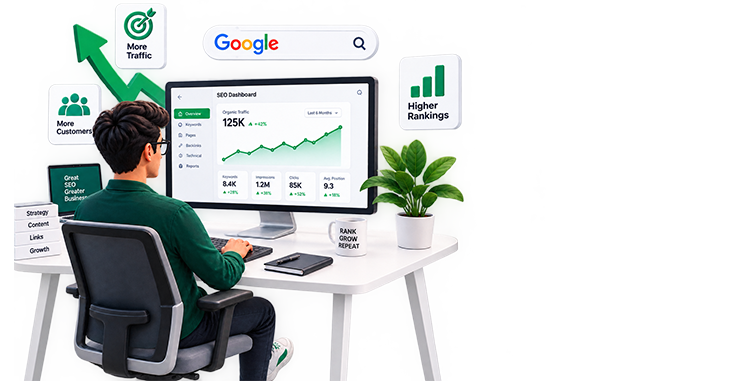
Search is no longer a single list of ten blue links. Buyers can discover a business through standard Google results, local packs, AI Overviews, answer-led experiences and AI assistants. The foundation remains strong SEO, but the information also needs to be clear enough for modern retrieval and generative systems to interpret.
Build crawlable, relevant and authoritative pages around the searches that can influence customer acquisition.
Strengthen legitimate local signals for eligible businesses through Google Business Profile, location relevance, reviews, citations and useful local pages.
Create concise, context-rich answers for the questions buyers ask without turning pages into thin FAQ collections.
Improve source quality, entity clarity, evidence and information structure so generative search systems can interpret important brand and service information more reliably.
Build consistent relationships between the brand, its services, expertise and authoritative external references. AI systems control their own outputs, so no specific citation or recommendation can be guaranteed.
Landing pages, calls to action and tracking shaped so stronger visibility can turn into measurable enquiries, calls or purchases.
We research how customers search, what the current SERP rewards and which queries are commercially meaningful. Keywords are grouped by intent, topic, funnel stage and page ownership so the strategy targets demand without creating cannibalization.
We compare the pages already earning visibility for priority searches and identify the gaps that matter: content depth, page type, technical quality, authority, local relevance, trust, user experience and conversion.
We diagnose crawlability, rendering, indexation, canonicalization, redirects, sitemaps, site architecture, Core Web Vitals, structured data, JavaScript and migration issues that can suppress search performance.
We optimize titles, descriptions, headings, content, entities, internal links, media and calls to action around the intent each page needs to satisfy. Relevance comes from clarity and completeness, not artificial keyword density.
For eligible local businesses, we improve Google Business Profile, Maps relevance, local landing pages, citations, reviews and consistent entity information. We do not use fake addresses or mass-produce doorway pages.
We improve category and product discovery, faceted navigation, crawl control, internal linking, product data, structured data, inventory-change handling and organic revenue opportunities.
Large websites need scalable rules and governance. We support template optimization, technical controls, content operations, automation, release QA, international architecture and prioritization across teams.
We plan commercial pages, topic clusters, expert resources, comparison content and content refreshes around real search intent, information gaps and the role each asset plays in the buyer journey.
We focus on relevant editorial links, digital PR, linkable assets, unlinked brand mentions and credible external validation rather than chasing backlink counts or third-party authority metrics.
Our audits connect technical, content, architecture, authority, local and AI-search issues to a prioritized roadmap based on expected impact and implementation effort.
We reduce avoidable search risk during redesigns, replatforming, domain changes and URL migrations, and investigate organic losses through evidence rather than assuming every decline is an algorithm penalty.
Search-led page improvements focused on enquiry quality, friction reduction and measurable business outcomes.
A page may target the correct keyword and still underperform when it misses what the searcher actually wants to compare, evaluate or buy.
Overlapping service, city, industry and blog pages can split relevance and internal authority. Clear URL ownership is essential.
Rendering, indexation, canonical, internal-link, performance or template problems can hold back pages that would otherwise deserve visibility.
Publishing more pages is not automatically growth. Weak, repetitive or generic content can create noise instead of authority.
A backlink is useful because of its legitimacy, context and relationship to the destination page - not because a third-party tool gives the source a high score.
More organic sessions are not enough if the campaign cannot explain whether the right visitors are reaching the right pages and taking valuable actions.
A structured approach that connects search strategy, technical execution, content and measurement to meaningful business outcomes.
Understand the offer, customer, market, margins, priority services, locations and measurable business outcomes.
Establish the baseline across crawl/index health, architecture, content, backlinks, local visibility, analytics and conversion.
Map search demand, SERP competitors, entities, questions and content gaps by intent and business value.
Assign clear ownership across service, location, industry, product and informational pages.
Prioritize work by expected value, effort, dependency and risk instead of treating every SEO issue as equally important.
Fix constraints and strengthen the pages responsible for the most valuable search opportunities.
Build new content and external authority only where they support a defined topic, page or buyer need.
Connect search performance to forms, calls, demos, bookings, transactions, pipeline or revenue where reliable tracking is available.
Use query, page, technical, content and conversion data to refine what already exists before expanding blindly.
Rankings help diagnose progress, but they are not the final outcome. We focus reporting on the signals that explain whether SEO is creating useful demand.
Capture location-driven demand through legitimate Maps optimization, local pages, reviews, citations and market-specific search architecture.
Connect category architecture, products, technical SEO, content, authority and conversion to organic product discovery and revenue.
Target solution, use-case, integration, comparison and problem-aware searches that influence longer buying journeys.
Structure search around courses, programs, locations, student questions, comparisons and useful informational resources.
Map project, property, locality, service and research intent without creating thin location pages.
Combine local discovery with factual accuracy, expertise, trust signals and clear service information.
Scale technical rules, content governance, international architecture and implementation across complex websites.
Location-led demand, reputation signals and high-intent service pages built for enquiries.
Web development is our second core capability because search performance is easier to protect when SEO requirements are considered before the site is launched.
We build and improve websites around crawlable architecture, semantic structure, performance, content management, analytics and conversion. That reduces the common problem of launching a visually strong website and then paying to repair its search foundation.
Explore Web Development →Software development is our third core capability. We design digital systems around real workflows when standard tools cannot provide the control, automation or customer experience the business needs.
Explore Custom Software Development →Build customer-facing products, portals and subscription platforms.
Create tailored systems for operations, customers, inventory, reporting and internal workflows.
Give teams role-based visibility and control over the information used to run the business.
Connect websites, applications, payments, third-party platforms and data sources.
Reduce repetitive work by connecting systems, rules and business processes.
Internal systems for content briefs, QA checks, reporting workflows and recurring campaign tasks.
Many SEO recommendations eventually become development work: architecture changes, template fixes, schema, performance, rendering, analytics, landing pages or CMS improvements. When strategy and implementation are disconnected, important fixes can remain in a backlog for months.
Digital Fabric Lab combines SEO thinking with web and software capability so recommendations can be designed with implementation in mind. Development is not forced into every SEO engagement; it is available when the search strategy genuinely needs technical execution.
It seems that only fragments of the original text remain in the Lorem Ipsum texts used today. One may speculate

With the rise of artificial intelligence technology, many changes have been made in the sphere of people's searching for information, researching vari...
The importance of social media in digital marketing has increased. Facebook, Instagram, LinkedIn, YouTube, X, Pinterest, Reddit, and other such media...
If your business is losing valuable search demand because of technical issues, weak page targeting, generic content, low authority, poor local visibility or changing search behavior, the first step is to identify the real constraint.
Digital Fabric Lab combines search strategy, technical execution, content and authority into one prioritized SEO roadmap built around the queries and pages most capable of creating qualified growth.
Tell us what you are trying to grow, where search is currently stuck and what outcome matters most.
+91 9837876833
digitalfabriclab@gmail.com
Shop no.B-1 U.G.F Burlington arcade mall, bearing corporation no.47/CC, vidhan sabha marg, Lucknow 226001
Mon - Sat 08:00 - 20:00